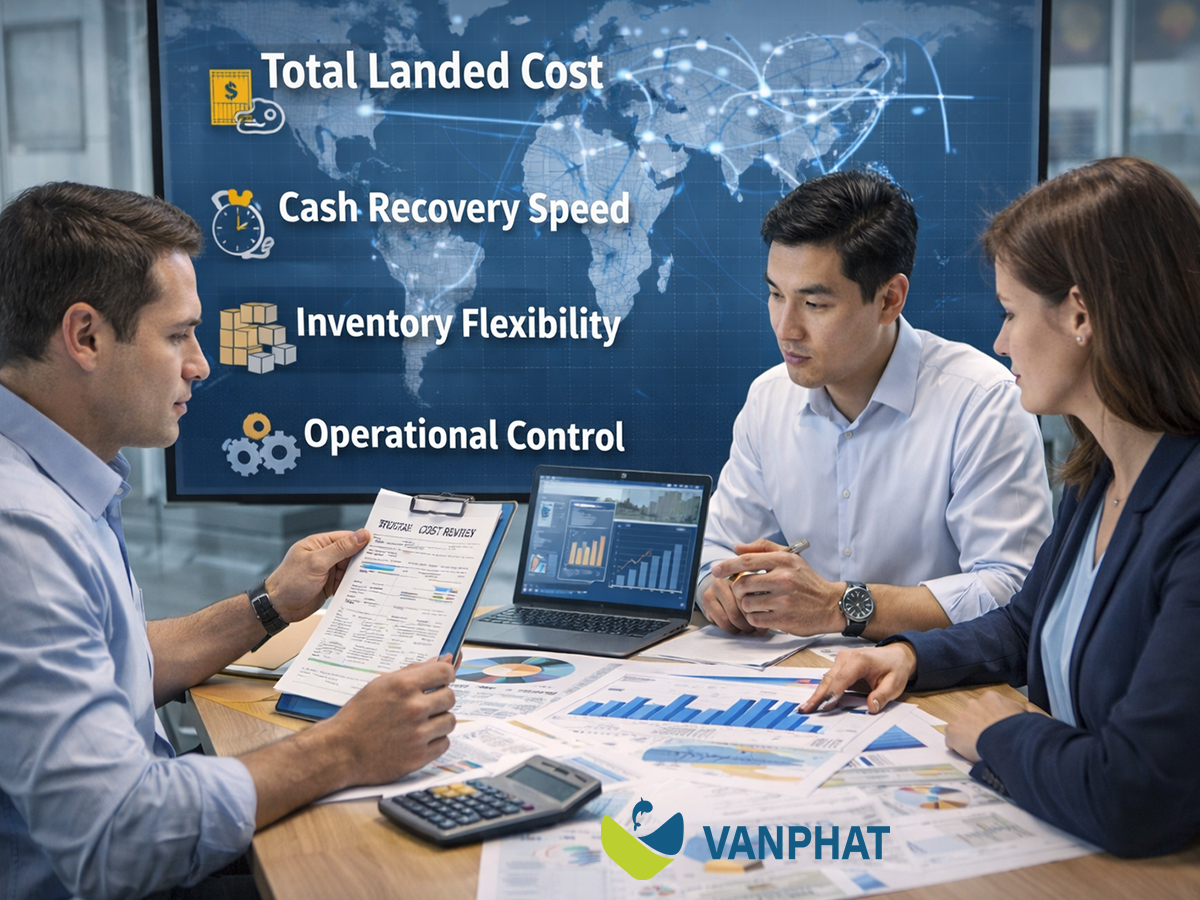
For many SME buyers, seafood import cost beyond price is the real challenge hidden behind every quotation. Yet in practice, most sourcing conversations still begin with a single question: “What’s your price per kilo?”
That reaction is understandable. Margins are tightening, freight costs remain volatile and competition among frozen seafood importers is more intense than ever.
Together, these factors define the true seafood import cost beyond price, shaping whether a deal strengthens or quietly undermines an SME’s business. Behind every quotation for pangasius, basa fillet, black tiger shrimp or tuna loins lies a chain of operational decisions. Payment terms determine how long cash remains tied up. Minimum order quantities drive inventory pressure. Quality control decides whether goods move smoothly into sales or turn into claims. Logistics choices influence delivery timing, risk exposure and unexpected charges.
At VanPhat Imex, we work closely with frozen seafood wholesalers, frozen seafood distributors and seafood importers across multiple markets. This article explains why successful buyers look beyond unit price and how a broader operational mindset is essential for sustainable growth in today’s seafood trade.
Key takeaways
- Payment terms are risk allocation; negotiate milestones tied to inspection and document readiness.
- MOQs drive inventory pressure-optimize SKU mix, packaging formats, and shipment frequency instead of blindly accepting factory defaults.
- Quality control is a system: define specs, AQL, sampling, corrective actions, and claim handling before production starts.
- Logistics choices (FCL vs LCL, reefer handling, port charges) change landed cost and delay risk more than many buyers expect.
- Always compare suppliers on landed cost + delay scenarios, not FOB price.
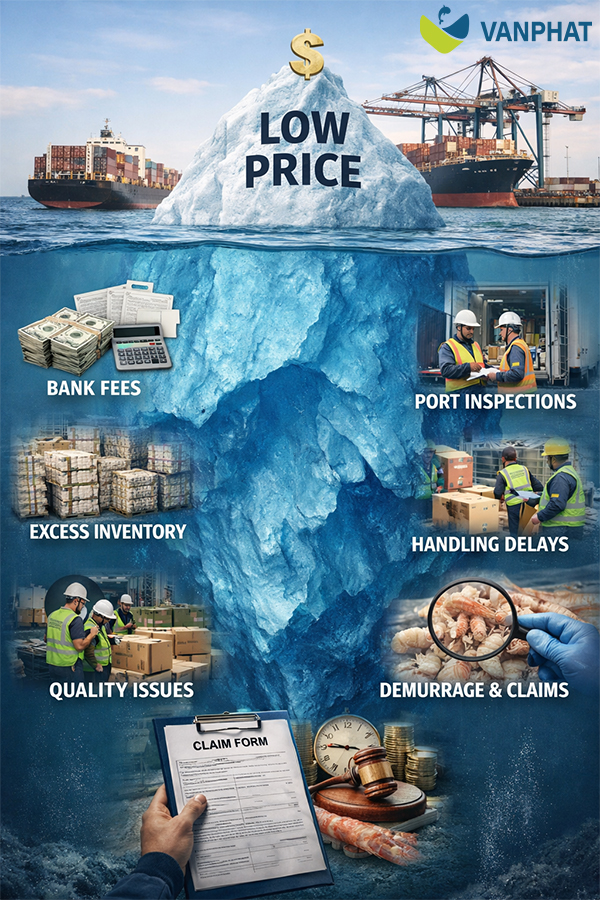
The Iceberg Effect: Seafood Import Cost Beyond Price
The quoted price for pangasius, basa fish, vannamei shrimp or tuna loins is only the visible tip of the iceberg.
Below the surface are hidden costs that many buyers underestimate:
- Bank fees and frozen capital from rigid payment terms
- Excess inventory caused by high MOQs
- Quality disputes that delay sales or force markdowns
- Extra handling charges linked to poorly structured LCL shipments
- Claims, inspections, demurrage and lost customer trust
This is why many frozen seafood importers discover that the “cheapest” seafood supplier becomes the most expensive once the container arrives. In 2026, rising inspection intensity, port handling fees and compliance checks mean these hidden costs often outweigh small price differences quoted by a seafood supplier.
The real question SMEs should ask is not “Who offers the lowest price?” It is “Who helps me control risk, cashflow and execution?”
This iceberg effect explains why seafood import cost beyond price matters far more than headline pricing for SME buyers.
Cashflow First: Choosing Payment Terms That Don’t Strangle Your Business
Payment terms are a core driver of seafood import cost beyond price, because they decide who carries risk and how long capital stays locked.
Advance Payment (T/T): Fast and Simple, but Risky
Advance payment is common when working with a new seafood supplier. While simple and fast, it places most of the risk on the buyer. Delays, grading disputes or documentation errors can immediately impact cash recovery.
Experienced seafood importers mitigate this risk by:
- Structuring staged payments
- Linking final payment release to inspection and document verification
Documentary Collection (D/P): A Practical Middle Ground
Documentary collection operates under the ICC’s Uniform Rules for Collections (URC 522) and offers a practical middle ground for SME buyers. Documents are released only after payment, which reduces fraud risk. However, frozen seafood shipments are highly time-sensitive, and even short document delays at port can quickly translate into storage costs and shelf-life pressure.
Letter of Credit (L/C)
Letters of credit offer security, but they also introduce strict documentary compliance requirements governed by ICC’s Uniform Customs and Practice for Documentary Credits (UCP 600). For SMEs, discrepancies in documents can delay payment, increase bank fees and freeze working capital longer than expected.
For low-margin products such as pangasius, basa fish or tilapia fish, L/Cs frequently reduce competitiveness rather than improve it.
Open Account and Consignment

Open account and consignment terms only work when trust has been built over time and operations are transparent on both sides.
They are most effective when:
- The exporter understands the buyer’s sales cycle and market reality
- The buyer operates with clear reporting and predictable payment behavior
This is where long-term partnerships consistently outperform transactional sourcing.
At VanPhat IMEX, we often design hybrid payment structures that reflect real operating conditions. By balancing risk, timing and trust, we help seafood importers grow volumes while keeping cashflow stable and under control.
MOQ Reality Check: When Bigger Orders Create Smaller Profits
In practice, MOQ decisions directly increase seafood import cost beyond price when inventory turns slow High MOQs may look efficient on paper, but in practice they often create serious pressure for SMEs.
Why High MOQs Hurt Small Buyers
- Capital frozen in slow-moving inventory
- Rising cold storage costs
- Slow-moving SKUs erode margins
This is especially challenging for importers handling diversified portfolios, including pangasius steak, basa fillet, multiple tuna types, mackerel and mixed shrimp sizes.
MOQs are a production convenience, not a buyer requirement
Most exporters set MOQs to optimize factory runs, not buyer profitability.
An experienced sourcing partner helps:
- Split production across shipments
- Consolidate SKUs intelligently
- Align order volumes with realistic sell-through timelines
For frozen seafood distributors, MOQ flexibility directly protects margins.
Quality Control: The Cheapest Insurance in Seafood Trade
Quality control is not about chasing perfection. It is about avoiding costly surprises once the shipment arrives. For SME buyers, effective quality control reduces claim risk, protects cashflow and ensures products can move directly into sales without disruption.

Without proper QC, importers face risks such as:
- Species substitution (black tiger shrimp replaced by vannamei)
- Misgrading of basa fillet or incorrect classification of tuna cuts
- Temperature abuse during handling or transport that shortens shelf life
- Nutrition and labeling inconsistencies, increasingly scrutinized in 2025 inspections
What Effective QC Actually Covers
Effective quality control relies on structured sampling and inspection protocols. In practice, many importers apply lot-by-lot inspection methods aligned with the ISO 2859-1 AQL sampling standard to verify grading, net weight, glazing and labeling accuracy before shipment.
- Species and cut verification
- Sensory checks (color, odor, texture)
- Temperature and cold-chain integrity
- Packaging and labeling accuracy
- Traceability for responsibly sourced seafood
Many suppliers mention quality control in principle. Very few connect it directly to payment release and shipment planning. At VanPhat Imex, quality checks are tied to financial decisions from the start, not handled as a final formality.
Logistics Is Risk Management, Not Just Transport
For many SME seafood importers, logistics is still viewed as a freight decision. In 2025–2026, logistics decisions are more critical than ever due to tighter cold-chain inspections and port controls.
LCL vs FCL: A Quiet Decision With Major Impact
For SMEs, an LCL shipment often looks attractive at first glance. The upfront freight cost is lower and it allows buyers to move smaller volumes while testing new SKUs or markets.
However, LCL shipments come with hidden risks that are frequently underestimated:
- Extra handling during consolidation and deconsolidation, which increases the chance of delays
- Higher risk of damage or cross-contamination when sharing container space with other cargo
- Less predictable arrival schedules due to dependency on multiple shippers and documents
In frozen seafood, these risks multiply. Temperature deviations during additional handling can reduce shelf life, trigger quality claims, or even lead to rejection at destination. Industry data shows that LCL cargo typically passes through two to three more handling points than FCL, increasing exposure at each stage.
A Middle East importer supplying pangasius fillet and vannamei shrimp learned this the hard way. LCL delays reduced remaining shelf life, forcing discounts despite acceptable product quality. Switching to FCL improved delivery reliability and lowered total landed cost per kilo.
The issue was not product quality. It was the logistics structure.
FCL shipments offer a different risk profile:
- Better temperature stability through sealed, dedicated containers
- Faster customs clearance supported by simpler documentation
- Fewer touchpoints, reducing the risk of physical damage and temperature abuse
After restructuring future shipments into FCL, the same buyer achieved more predictable transit times, faster clearance and better shelf life upon arrival. Freight cost per container increased on paper, but total landed cost per kilo declined once delays, discounts and operational friction were removed.
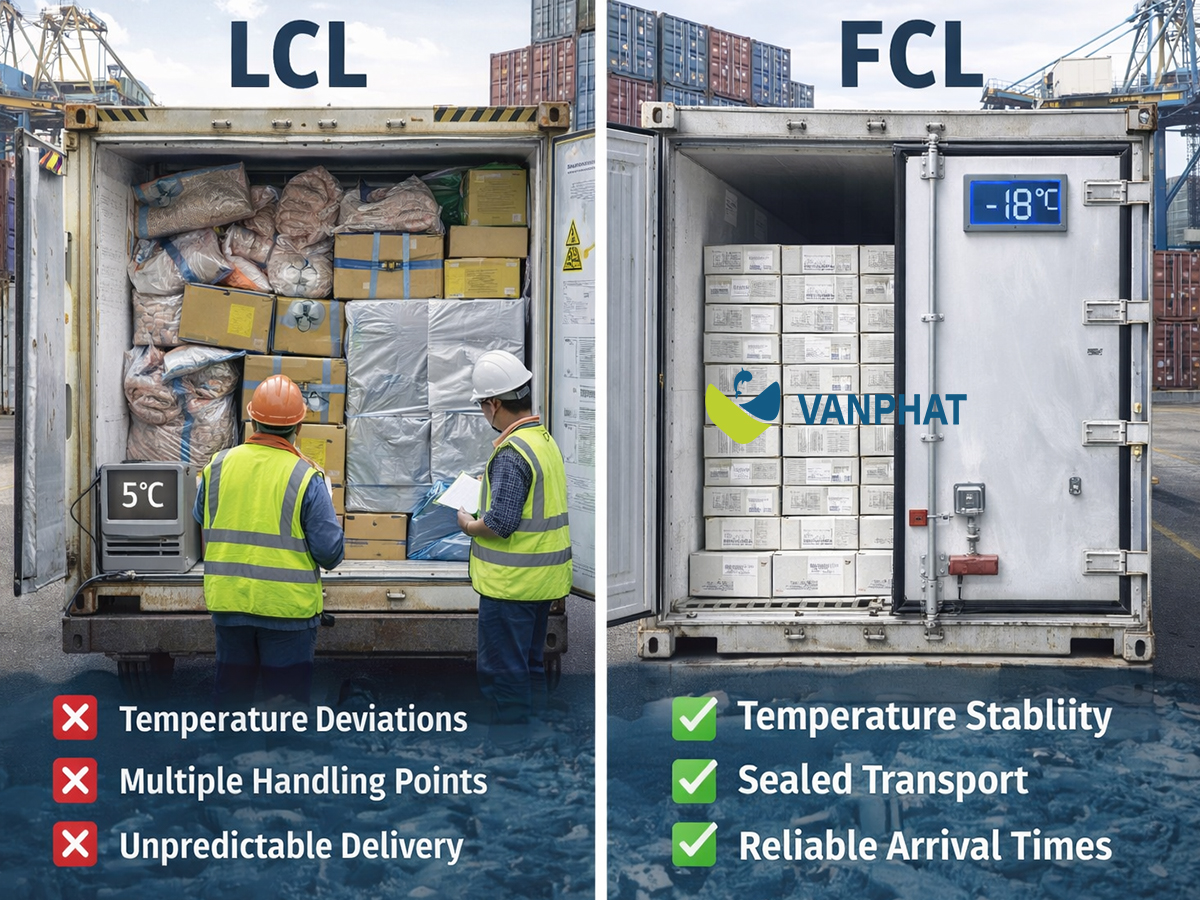
In practice, the right choice depends on shipment volume, SKU mix, destination requirements and cashflow planning. It should never be based on freight quotes alone.
Incoterms: Control Matters More Than Convenience
FOB, CIF and CFR are often treated as routine contract terms. In reality, they define operational control, risk allocation and responsibility across the shipment lifecycle, as clarified under Incoterms® 2020 issued by the International Chamber of Commerce.
They determine:
- Who controls the freight arrangement
- Who manages insurance coverage
- Who absorbs delays, surcharges and operational disruptions
Many SMEs choose CIF because it appears simpler and shifts logistics responsibility to the exporter. Problems usually surface only when something goes wrong. Under CIF, buyers often discover that insurance coverage is minimal, claims are slow and freight decisions are outside their control.
Recent changes in carrier surcharges, port handling fees and inspection procedures have made this loss of control more costly than before. Buyers without visibility into freight and insurance are often the last to react and the first to absorb unexpected costs.
At VanPhat IMEX, we advise buyers based on current operational realities, not textbook definitions. Incoterms are selected to match risk tolerance, logistics capability and market-specific regulations, ensuring that control sits where it matters most.
What Many Suppliers Overlook and Buyers Pay For
Here is what many exporters won’t openly discuss:
- How payment terms affect your ability to reorder
- How MOQ influences your pricing power downstream
- How logistics decisions impact claim success
- How QC failures delay cash recovery
These topics require real trade experience, not marketing slogans.
Why VanPhat IMEX Thinks Beyond Products
Seafood is where the conversation usually starts. VanPhat IMEX supplies a wide range of products, including:
- Basa fish and basa fillet
- Pangasius and pangasius steak
- Black tiger shrimp and vannamei
- Multiple tuna types
- Mackerel and tilapia fish
But products alone do not determine whether an import business succeeds.
In volatile markets, seafood importers need partners who understand cashflow, inventory risk and execution. As a seafood supplier and sourcing partner, VanPhat Imex supports buyers by:
- Structuring payment terms aligned with market realities
- Aligning MOQs with actual demand
- Integrating QC into financial milestones
- Designing logistics solutions that protect shelf life and margins
This approach is how SMEs stay resilient when prices fluctuate, regulations tighten and demand shifts. At VanPhat Imex, thinking beyond products is not a slogan. It is how we help our partners operate with confidence in uncertain markets.
The Right Mindset for Sustainable Seafood Imports
For resilient SME buyers, managing seafood import cost beyond price is the foundation of sustainable importing, not an afterthought. Instead of chasing the lowest price, they make decisions based on a broader set of priorities that protect the business beyond a single transaction.
Their focus is on:
- Total landed cost rather than headline pricing
- Speed of cash recovery and capital turnover
- Inventory flexibility in changing market conditions
- Operational control across sourcing, quality and logistics
Price still matters, but only after risk has been properly managed. This is the mindset that VanPhat Imex brings to every partnership in 2025 and beyond – helping seafood importers operate confidently in an increasingly complex global market.